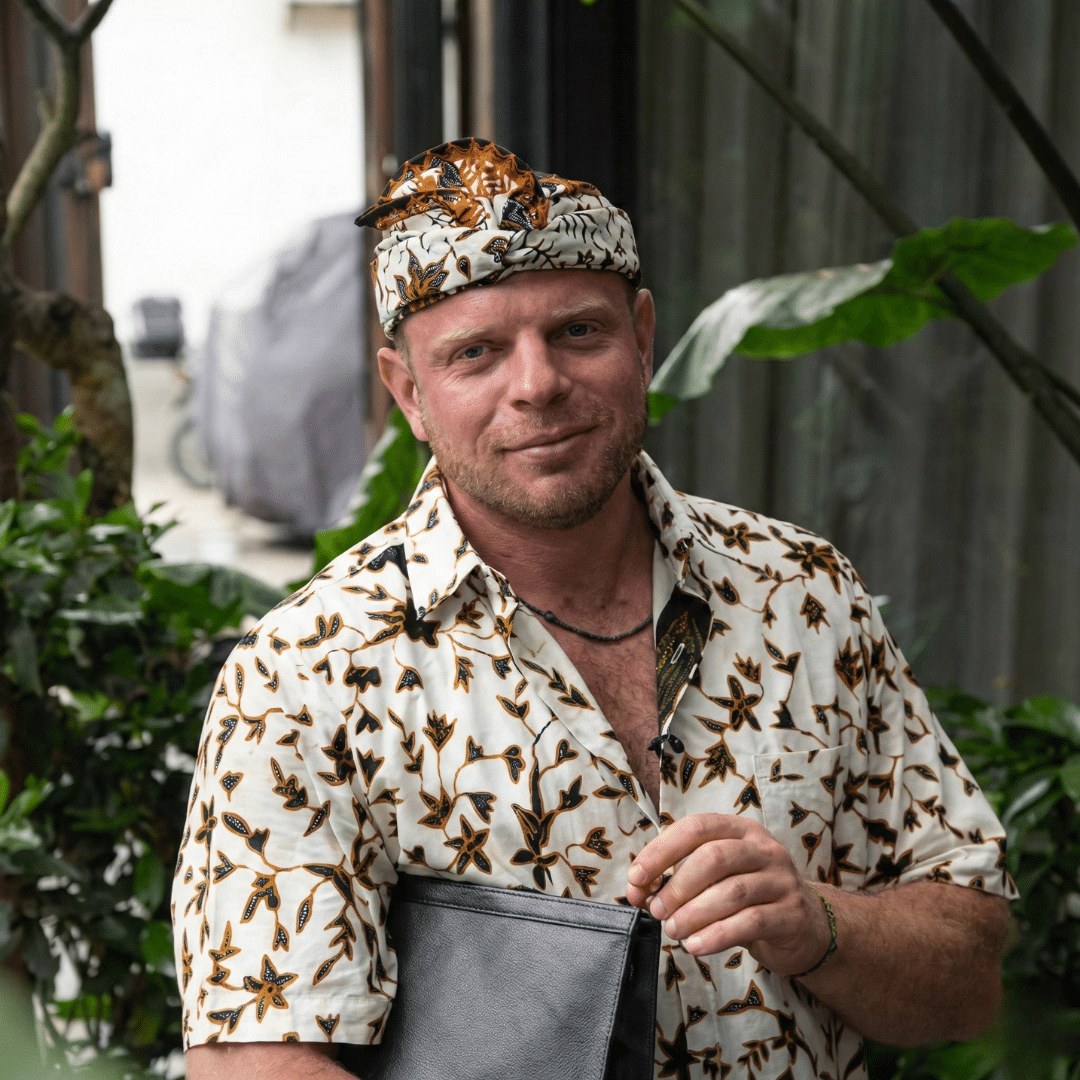
He goes and finds it, then builds it in.
Fedor Vlaskin has lived in Bali since 2017. Rumah Archipelago means home on the archipelago, and he takes the second word literally: the roof timber comes from Kalimantan, the floor tiles are still pressed by hand in Java, the pool is the shape of a lake in Sulawesi. He runs the site visits himself and answers the WhatsApp himself, in your hours.
“We focus on thoughtful design, reliable construction, and long-term value, offering homes that are both exceptional living spaces and smart investments.”
Also on Instagram as @fedya_vlaskin.
What he brings back
Seventeen thousand islands, one house at a time“Every island is unique: culture, languages, food, its own word for the same thing, religion. And seventeen thousand islands. I am getting to know this country and I show it in the houses I build — every one of them has something real from here: the roof, the wood, the tile, the way a room opens into the garden.”Fedor, 1 September 2026
“The wood that is not afraid of water, termites or mould.” The floors are recycled ironwood and the beams are Bangkirai, cut at Kalimantan sawmills. It is the most expensive way to roof a house here and the last one you have to think about again.
Tegel Kunci — the interlocking cement tile Indonesia has been laying since the colonial era, made one at a time. They go down through La Casa Española between the whitewashed walls and the arches, which is where the Spanish half of the house meets the Javanese half.
He swam in Paisupok Lake on Banggai — clear water held in jungle — and built it into the villa: Sukabumi volcanic stone underwater, planting spilling off the balcony to the water’s edge, a frangipani over it because that tree is Bali.
“Sikagard 707W, so the iron in the stone does not oxidise and go brown over time.” Volcanic stone has iron in it; left alone it stains within a few seasons. Sealed, the colour holds and it wipes clean. Nobody buying the villa would ever have known to ask.
Also on the drawings: teak through the furniture, heavy steel WF 200 in the frame, Quadra surfaces in the kitchen, and a garden planted to bring the Balinese birds back. The build notes go into the parts you cannot see →
The rules he does not move
The same on every project since the firstHe is on all three sides of a villa: the company draws it, builds it, and then rents and manages it for owners who are not in Bali. So the people who poured the slab are the people you ring about it afterwards, and a corner cut in year one comes back to the same team in year five. Three things have not changed across five projects.
“A fully independent villa — their own walls, not connected to any other building.” It is the expensive way to lay out a plot: shared walls fit more units on the same land. It also means complete privacy, and that you can change the outside of your house later without asking a neighbour.
“Furniture crafted and installed, appliances fitted, decor curated, greenery in place — so that handover day is the beginning of the experience, not the start of a to‑do list.” Tropical Loft, the first project, set it; every one since has been delivered the same way.
A villa has to work twice over: as somewhere to be, and as something still worth owning in ten years. The second is settled almost entirely by the waterproofing, the foundation and the sealant on the stone — the three things no buyer ever sees.
What goes in the concrete →What he is trying to build next
Archipelago Ubud ResortThe villas are the work he is known for. The thing he actually wants is bigger: a five‑star boutique resort above the river in Ubud — restaurant under Mount Agung, an infinity pool into the jungle, one‑ and two‑bedroom villas kept private, three‑ and four‑bedroom houses for sale.
He has been hunting the land for it since June 2026, in the corridor between Ubud, Tegallalang and the waterfalls, next to resorts that are already there. The plot he is walking now is 146 are: seven parts flat, for the pool and the restaurant and the spa; three parts falling away to a mountain river, which is where the private houses would go.
Which is also the clearest thing about how he works. He turned down the first plots that looked right, and he will not draw anything until the soil tests and the zoning come back.
“We scouted a few promising plots today, but we don’t settle. The team is sourcing more options in this exact area until we find the perfect canvas.”Fedor, 3 June 2026“A great view isn’t enough.”22 June 2026, on the 146‑are plot
The part he will not shut up about
4 projects handed over“Creating something new is my way of speaking to the world. Through design, architecture, building homes, media, and storytelling — this is my life. Nothing makes me happier than seeing a client’s dream come true: hearing how he imagines life with his family in his villa. And honestly, I already feel shy calling them clients. For us, they are family. Friends.”Fedor, 19 August 2025
Four projects handed over — Tropical Loft in Padonan, Taman in Batu Bolong, Magic Story and La Casa Española in Bingin — and every one of them sold out before it was finished. La Casa Española II is the fifth.
He is a poor salesman in one specific way: ask him about a villa and you will get twenty minutes on where the tile is pressed. “Design that reflects who you are, not just what’s trending” is his line, and he means the tile.